


The Up Plex Mission
Elevating others by providing wealth-building, passive investment opportunities through real estate.
It’s a known fact that owning real estate can be one of the best passive investment vehicles for you. More specifically, apartment buildings and commercial real estate. However, it also comes with an incredible amount of complexities in trying to acquire such assets and we’ve found that to be the reason most beginner investors shy away from pursuing.
So we set out to make it more attainable for investors to invest in these incredible wealth-building assets with confidence. As a limited partner, you get to leverage our time, network, and decades of experience to create peace of mind with every investment you make with us. We do our best to mitigate as much risk as possible. So much so that we won’t offer an opportunity that we aren’t investing in ourselves.

The Up Plex Mission
Elevating others by providing wealth-building, passive investment opportunities through real estate.
It’s a known fact that owning real estate can be one of the best passive investment vehicles for you. More specifically, apartment buildings and commercial real estate. However, it also comes with an incredible amount of complexities in trying to acquire such assets and we’ve found that to be the reason most beginner investors shy away from pursuing.
So we set out to make it more attainable for investors to invest in these incredible wealth-building assets with confidence. As a limited partner, you get to leverage our time, network, and decades of experience to create peace of mind with every investment you make with us. We do our best to mitigate as much risk as possible. So much so that we won’t offer an opportunity that we aren’t investing in ourselves.

Chris Linger
Principal
Chris Linger has an MBA, twenty seven years of active duty Navy services (ret), now full-time apartment syndicator (underwriter and asset management). Mentor to hundreds of aspiring investors.

Maricela Soberanes
Principal
Maricela has been investing in Real Estate since 2006 in Austin TX. She successfully grew a personal rental portfolio before becoming a full-time syndicator. She’s a Navy veteran, self-published author, and a medical missionary to third world countries.
Chris Linger
Principal
Chris Linger has an MBA, twenty seven years of active duty Navy services (ret), now full-time apartment syndicator (underwriter and asset management). Mentor to hundreds of aspiring investors.
Maricela Soberanes
Principal
Maricela has been investing in Real Estate since 2006 in Austin TX. She successfully grew a personal rental portfolio before becoming a full-time syndicator. She’s a Navy veteran, self-published author, and a medical missionary to third world countries.
Our Success Formula

Underwriting & Negotiating
Detailed underwriting determines the amount of negotiating that can be done with a seller on price and terms. Our experience allows us to properly analyze an asset and mitigate as much risk as possible for our investors.

Contract Review / Due Diligence
We have established the best legal and due diligence teams for our syndications. This allows us to simultaneously expedite two incredibly time-consuming tasks that most beginning investors struggle with.

Closing & Reassessment
There is more to closing than just signing on the dotted line and handing over the keys. There is an equal amount of critical work that needs to be completed soon after to ensure the success of a syndication.

Enacting Business Plan / CapEx
We identify and prioritize the necessary projects and execute them based on funding and critical need. Simultaneously, our expert CapEx team gets to work by coordinating with asset and property managers to assist in stabilizing the property.

Stabilization / Refinance
This process usually takes just over 2 years (depending on the market) and involves everything from completing CapEx, to ensuring organic fair market rent growth, to managing tenant turnover, all while working to decrease expenses.

Sale/Disposition
When it comes time to sell, we prepare the property to show as cost-effectively as possible. Once sold, we ensure that we properly close out business transactions and 3 months after the sale, we deliver all sales proceeds (return of capital) to our investors.
Our Success Formula
Underwriting & Negotiating
Detailed underwriting determines the amount of negotiating that can be done with a seller on price and terms. Our experience allows us to properly analyze an asset and mitigate as much risk as possible for our investors.
Contract Review / Due Diligence
We have established the best legal and due diligence teams for our syndications. This allows us to simultaneously expedite two incredibly time-consuming tasks that most beginning investors struggle with.
Closing & Reassessment
There is more to closing than just signing on the dotted line and handing over the keys. There is an equal amount of critical work that needs to be completed soon after to ensure the success of a syndication.
Enacting Business Plan / CapEx
We identify and prioritize the necessary projects and execute them based on funding and critical need. Simultaneously, our expert CapEx team gets to work by coordinating with asset and property managers to assist in stabilizing the property.
Stabilization / Refinance
This process usually takes just over 2 years (depending on the market) and involves everything from completing CapEx, to ensuring organic fair market rent growth, to managing tenant turnover, all while working to decrease expenses.
Sale/Disposition
When it comes time to sell, we prepare the property to show as cost-effectively as possible. Once sold, we ensure that we properly close out business transactions and 3 months after the sale, we deliver all sales proceeds (return of capital) to our investors.
Check Out Our Latest Blog
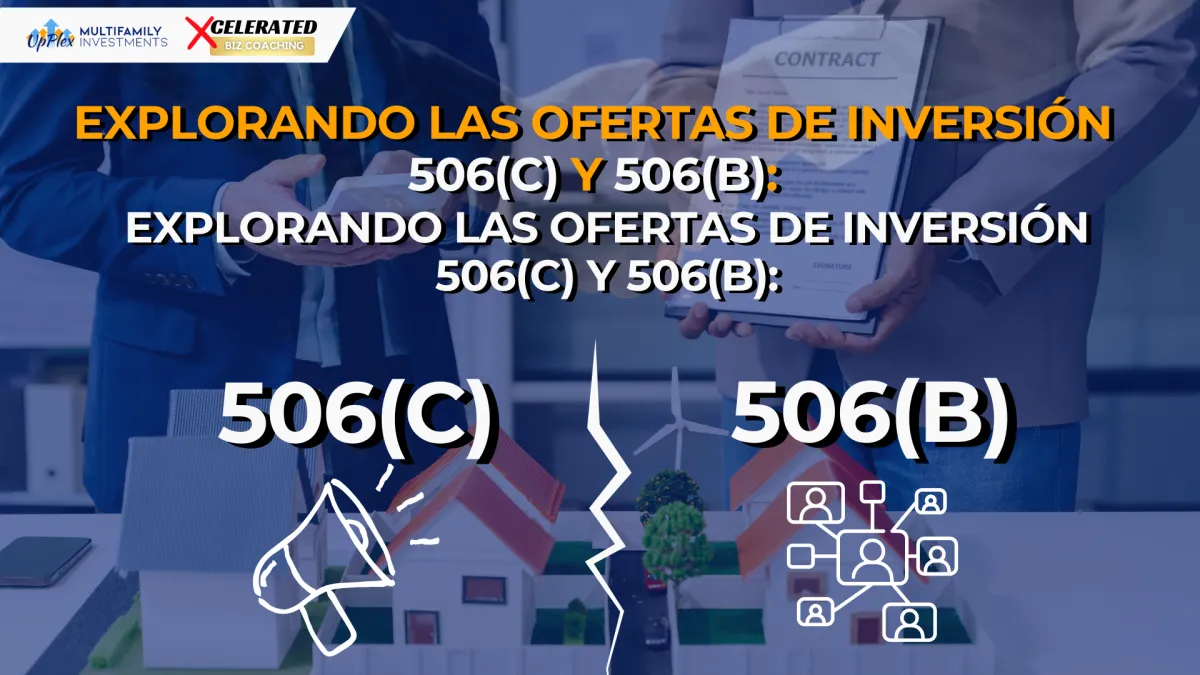
Explorando las Ofertas de Inversión 506(c) y 506(b): Descubriendo el Camino hacia las Inversiones Privadas
En el ámbito de las oportunidades de inversión, existen varias formas de recaudar capital, cada una con sus propias reglas y criterios. En los Estados Unidos, dos opciones bien conocidas para inversiones privadas son la oferta 506(c) y la oferta 506(b). En este blog, exploraremos las características, diferencias y ventajas de estas dos opciones de inversión. Por lo tanto, ya sea que seas un inversionista o un patrocinador que busca financiamiento, sigue leyendo para obtener una discusión detallada sobre estas alternativas.
Estas son algunas de las preguntas más comunes que recibimos:
Chris y Maricela, ¿tengo que ser un inversionista acreditado para invertir con ustedes? ¿Necesito enviar mis estados financieros a su equipo para determinar si califico para invertir en sus ofertas? ¿Por qué solo publican algunos de sus acuerdos en redes sociales y otros solo los mencionan por correo electrónico o en seminarios web?
Bueno, este blog tiene información para ayudarte a responder estas preguntas. La respuesta corta es: depende del tipo de oferta de inversión (506B o 506C), lo cual dicta cómo se anuncia la oportunidad de inversión. Vamos a profundizar.
Entendiendo la Oferta 506(c): La oferta 506(c) es un tipo de exención de colocación privada proporcionada por la Comisión de Bolsa y Valores (SEC) bajo la Regulación D. Permite a las empresas recaudar fondos de inversionistas acreditados mediante publicidad pública y solicitud general. Sin embargo, incluye estrictos criterios de elegibilidad, centrándose principalmente en la verificación del inversionista.
Inversionistas Acreditados: Para participar en una oferta 506(c), los inversionistas deben cumplir con la definición de inversionista acreditado, que generalmente incluye individuos con un alto patrimonio neto o ingresos, inversionistas institucionales y ciertas entidades.
Publicidad Pública: Una ventaja clave de la oferta 506(c) es la capacidad de participar en publicidad pública. Esto significa que las empresas pueden promover abiertamente sus oportunidades de inversión a través de diversos canales como sitios web, redes sociales y métodos de publicidad tradicionales.
Verificación del Inversionista: A diferencia de la oferta 506(b) (que discutiremos a continuación), la oferta 506(c) requiere que las empresas tomen medidas razonables para verificar que todos los inversionistas sean acreditados. Este proceso de verificación implica evaluar los ingresos, el patrimonio neto, las certificaciones profesionales y otros documentos relevantes del inversionista.
Explorando la Oferta 506(b): La oferta 506(b), que también cae bajo la Regulación D, es otra exención de colocación privada común. A diferencia de la oferta 506(c), la oferta 506(b) permite un grado limitado de relaciones preexistentes entre el emisor y los inversionistas, pero prohíbe la publicidad pública o la solicitud general.
Relaciones Preexistentes Limitadas: Bajo la oferta 506(b), las empresas pueden aceptar inversiones de hasta 35 inversionistas no acreditados, además de un número ilimitado de inversionistas acreditados. Sin embargo, el emisor debe tener una relación sustantiva con estos inversionistas no acreditados antes de ofrecerles la oportunidad de inversión.
Sin Publicidad Pública: Una diferencia notable entre la oferta 506(b) y la oferta 506(c) es la ausencia de publicidad pública. Los emisores deben confiar en su red existente de contactos, conexiones personales y otros medios privados para encontrar posibles inversionistas.

Diferencias Clave y Consideraciones:
Publicidad Pública:
La oferta 506(c) permite acceso a un grupo más amplio de inversionistas debido a la capacidad de publicitar públicamente, mientras que la oferta 506(b) restringe la publicidad y se basa en relaciones preexistentes.
Requisitos de Verificación:
La oferta 506(c) exige una rigurosa verificación de inversionistas, mientras que la oferta 506(b) se basa en la creencia razonable del emisor de que los inversionistas son acreditados.Cumplimiento Legal:
Ambas ofertas requieren el cumplimiento de diversas leyes y regulaciones de valores. Sin embargo, la oferta 506(c), con su proceso de verificación más estricto, ofrece un nivel más alto de certeza legal.Sofisticación del Inversionista:
La oferta 506(b) a menudo se considera más adecuada para inversionistas con relaciones preexistentes y una comprensión más profunda de la oportunidad de inversión. Por otro lado, la oferta 506(c) puede atraer a una gama más amplia de inversionistas, incluidos aquellos nuevos en colocaciones privadas.
Conclusión: Cuando se trata de colocaciones privadas, la elección entre una oferta 506(c) y una oferta 506(b) depende de factores como los objetivos de recaudación de fondos, la base de inversionistas y las preferencias. La oferta 506(c) permite la solicitud general, mientras que la oferta 506(b) es más adecuada para enfoques dirigidos y una participación limitada de inversionistas no acreditados. Los emisores deben considerar cuidadosamente sus circunstancias específicas y buscar asesoramiento profesional para determinar la mejor opción.
¡Felices inversiones, amigos!
Estas oportunidades no duran mucho tiempo. Únete a estas oportunidades para diversificar tus ingresos.
🚀 CONECTEMOS🚀

🚀 Suscríbete a nuestro canal de YouTube y únete a la comunidad de buscadores de conocimiento.
▶️ SUSCRÍBETE AQUÍ ▶️
Invierte con nosotros
🚀 ENLACE🚀
DEJA UNA RESPUESTA